Showing posts with label Judaism. Show all posts

Thursday, December 29, 2022

What Albert Einstein Thought of Christianity


Albert Einstein wearing a yarmulke at a synagogue in Berlin.


Einstein's preference for Judaism as a moral system.

Mein Weltbild, Amsterdam: Querido Verlag, 1934

"If one purges the Judaism of the Prophets and Christianity as Jesus Christ taught it of all subsequent additions, especially those of the priests, one is left with a teaching which is capable of curbing all the social ills of humanity.

It is the duty of every man of good will to strive to steadfastly in his own little world to make this teaching of pure humanity a living force, so far as he can. If he makes an honest attempt in this direction without being crushed and trampled underfoot by his contemporaries, he may consider himself and the community to which he belongs lucky."

(Albert Einstein, Ideas and Opinions, New York, Bonanza Books, 1954, pp. 184-185. Also, Einstein's The World as I See It,Philosophical Library, New York, 1949, pp. 111-112)


He believed that "Judaism is not a creed: the Jewish God is simply a negation of superstition..." (Ideas and Opinions, p. 186.)


Einstein's attitude toward the Roman Catholic Church.

In a 1940 issue of Time magazine, Einstein expressed a change of heart toward the Catholic Church for its role in opposing the Nazis:
"Only the Church stood squarely across the path of Hitler's campaign for suppressing truth. I never had any special interest in the Church before, but now I feel a great affection and admiration because the Church alone has had the courage and persistence to stand for intellectual truth and moral freedom. I am forced thus to confess that what I once despised I now praise unreservedly."


Einstein's appreciation for the uniqueness of Jesus.

Einstein expressed his attitude toward Jesus in an interview by George Sylvester Viereck that he gave to The Saturday Evening Post (October 26, 1929). He was asked, "To what extent are you influenced by Christianity?

Einstein replied, "As a child I received instruction both in the Bible and in the Talmud. I am a Jew, but I am enthralled by the luminous figure of the Nazarene."

When asked if he had read Emil Ludwig’s book on Jesus, Einstein stated, "Emil Ludwig’s Jesus is shallow. Jesus is too colossal for the pen of phrasemongers, however artful. No man can dispose of Christianity with a bon mot."

In the same interview, Einstein was asked if he accepted the historical Jesus.

He answered, "Unquestionably! No one can read the Gospels without feeling the actual presence of Jesus. His personality pulsates in every word. No myth is filled with such life. How different, for instance, is the impression which we receive from an account of legendary heroes of antiquity like Theseus. Theseus and other heroes of his type lack the authentic vitality of Jesus.” (Einstein, as cited in Viereck 1929; see also Einstein, as cited in the German magazine Geisteskampf der Gegenwart, Guetersloh, 1930, S. 235).

George Sylvester Viereck said, "Ludwig Lewisohn, in one of his recent books, claims that many of the sayings of Jesus paraphrase the sayings of other prophets."

"No man," Einstein replied, "can deny the fact that Jesus existed, nor that his sayings are beautiful. Even if some them have been said before, no one has expressed them so divinely as he."


Einstein on the relationship of Science and Religion.

"Science without religion is lame, religion without science is blind." ("Science, Philosophy and Religion: A Symposium", 1941.)


Saturday, June 22, 2013

Secular squatters on Biblical land


Jeff Fountain


Human dignity and rights needed to be set free from religious foundations. Only a secular basis can maintain their continued existence free from religious violence and tensions.

At least, that was the learned opinion one of Holland’s best-known atheists as expressed in a seminar last week in The Hague. Dr Margriet Krijtenburg, who spoke in Dublin at a recent State of Europe Forum, was presenting her doctoral thesis on Robert Schuman to an invited audience, and had invited her supervising professor, Paul Cliteur, to be one of her respondents.

As in Dublin, Margriet had described Schuman’s conviction that the Christian faith had a significant role to play in restoring unity in Europe and in Europe’s future. Concepts such as human dignity and solidarity were, in Schuman’s understanding, intrinsically linked with a Christian concept of humanity.

Margriet’s professor agreed that the identification of such values as the freedom of expression, of religion and of assembly had laid foundations for the unique European project. But fortunately, he said, those values had been set free from their religious roots and redefined within a sustainable secular framework. Such a framework protected human dignity from religious intolerance and offered it a tolerant pluriform context.

A few days after attending this seminar, an engagement near Den Bosch gave me the opportunity to visit the former Nazi concentration camp in Vught while in the neighbourhood.

Some 31,000 Jews, political prisoners, resistance fighters, students, Jehovah’s Witnesses, tramps, black marketeers and criminals were thrown together into Kamp Vught, some for short periods, others longer. Almost all of the 12,000 Jewish internees, over a third of the camp population, were later murdered in extermination camps in Poland.

A reconstructed cell remind visitors of the so-called “bunker drama” of January 15, 1944. In response to a protest by prisoners, the camp commandant ordered 74 women to be locked up together in one cell in a space of nine square metres, without ventilation. When the doors were finally opened after 14 hours, ten of the women had died.

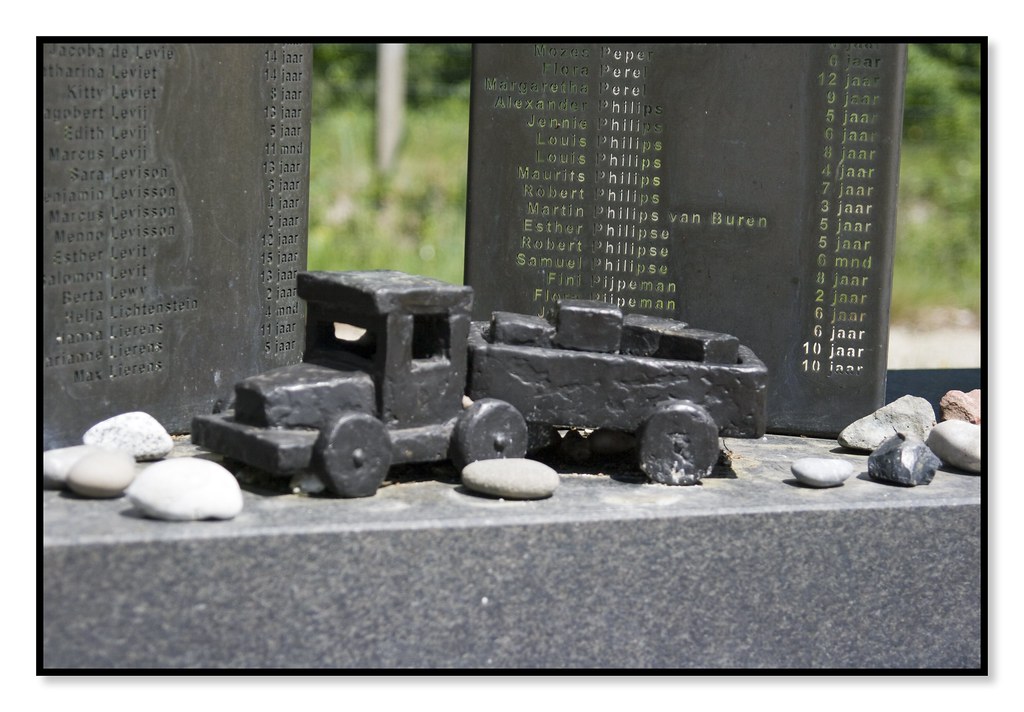
Most sobering, however, was a memorial to the 1,800 Jewish children taken away from the camp on June 6 and 7, 1943, to a “special children’s camp” -- or so the parents were told. Some parents were allowed to accompany the children. After a three-day train ride to the Sobibor extermination camp in Poland, almost every person perished.

The cold metal monument carried those names and ages of 1,269 of the children that are known. I stood there transfixed and emotionally disturbed reading the ages of these little defenceless human beings. I sought out the ages of my own three grandchildren: three months, two years and four years.


At the base of the monument was a sculptured teddy bear, a truck and other toys. In the trunk of my car was a wrapped present for my grandson celebrating his second birthday. What if he had been born 70 years earlier, to Jewish parents?

What was the source of the evil that had led to this vile crime? Was it not a denial of the Biblical truth that the dignity of every human is rooted in the understanding that life is a gift of the Creator? and that each one of us has been created in His image, Imago Dei?

Had not the “freeing from religious foundations”, the rejection of the Biblical view of humanity, by Hitler and his henchmen caused this European tragedy? Was it not this very tragedy that had led Schuman and others to formulate the European Convention on Human Rights, to which every member nation of the Council of Europe had to agree? Was it not their aim to render such “state gangsterism” impossible, to prevent for ever the atrocities of Kamp Vught, Dachau and Auschwitz?

How quickly we are forgetting this most important lesson of modern times! No, Professor, it is not “fortunate” that in the minds of millions of Europeans today human dignity has been freed from its historical and transcendent foundations. For there are no other foundations. We can’t invent foundations or roots. A process of materialistic evolution in which only the fittest survive can never result in protection and rights for the weak and vulnerable.

As (non-believer) John Gray, formerly of the London School of Economics, wrote in his 2007 book Straw Dogs: humanists are simply Christians in disguise. If there is no God, there is no basis for human dignity and human exceptionalism. Humanism is the creed of those who have “given up an irrational belief in God for an irrational belief in humans”.

The truth is, many Europeans are squatters living in a house built on Judeo-Christian foundations -- but they don’t want to pay the rent.


Jeff Fountain and his wife Romkje are the initiators of the Schuman Centre for European Studies in The Netherlands. This article has been republished here with permission from the Centre’s website.